street art

Speaking with Ever

August 18, 2013

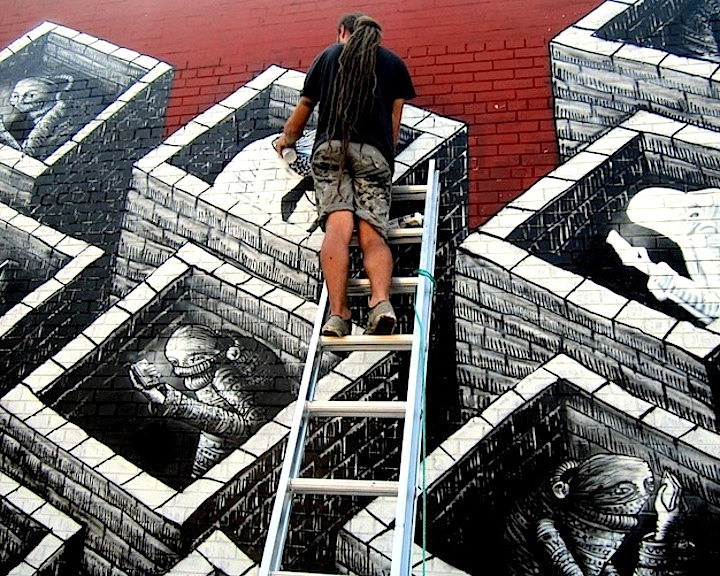
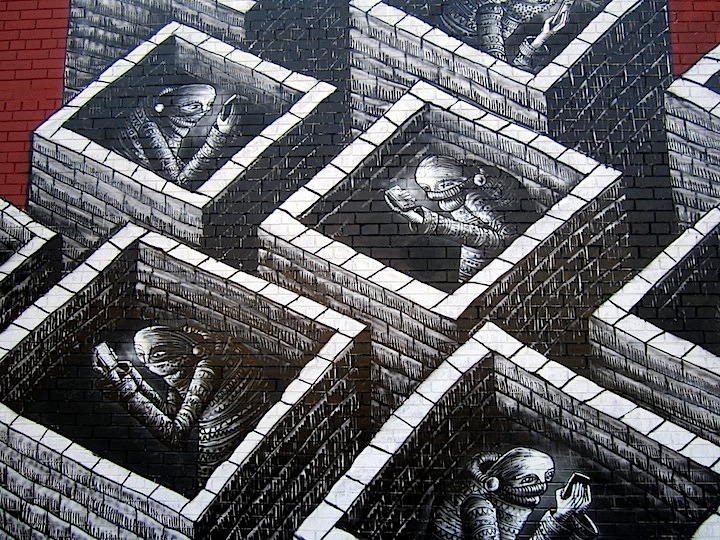
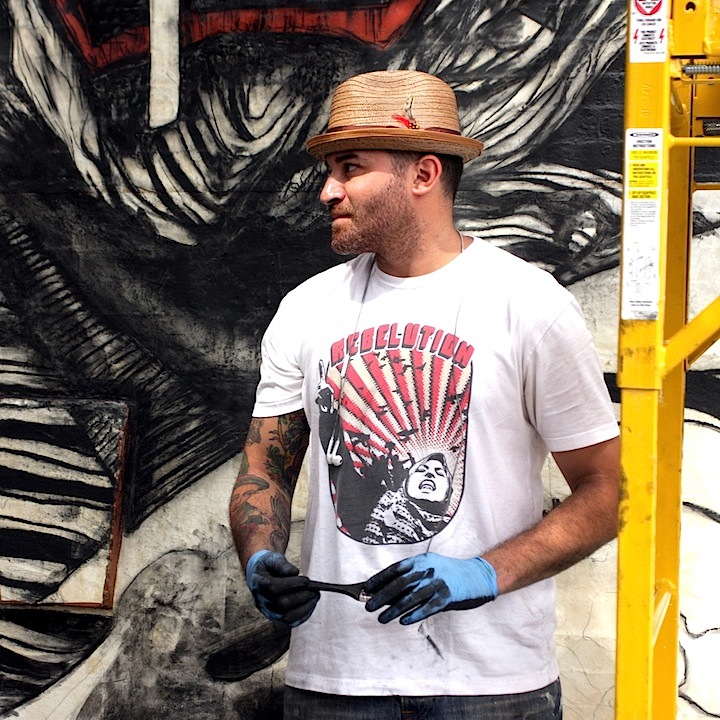
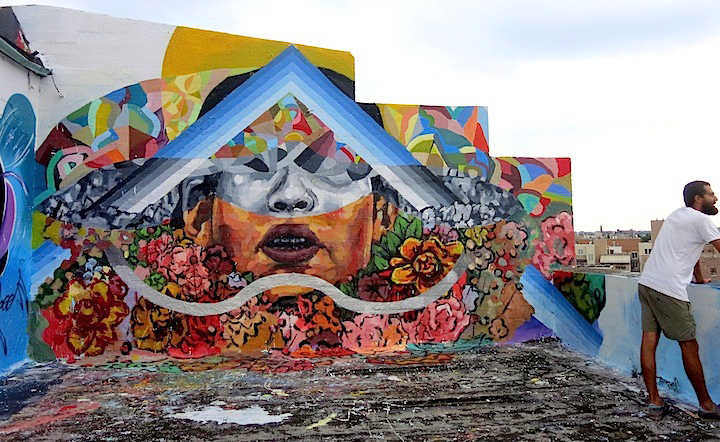
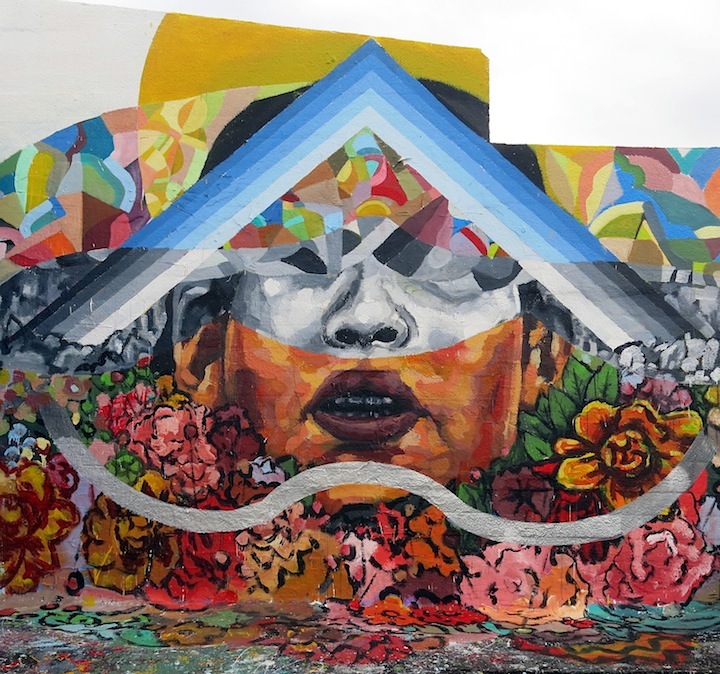
A masterful muralist and inspiring thinker, Argentinian artist Nicolás Romero aka Ever has graced countless cities throughout the globe with his wondrous vision. Earlier this summer, he stopped off in NYC, where he painted on a rooftop in Williamsburg, Brooklyn. That’s where I caught up with him.

Ever

When did you first start getting up?

I was 16 and into hip-hop. The first time I got up was with two friends in our school’s bathroom. We thought we were so cool. Then whenever I took my dog for a walk, I did throw-ups around my neighborhood.

So your neighborhood was your main canvas back then?

Mostly for bombing, but it made me nervous.

Ever-close-up-Brooklyn-Rooftop

When did you become serious about it?

When I met Jaz and other members of DSR. They were professionals. They took street art and public art seriously. I started to share a studio with Jaz and began to think of myself as an artist. In 2003, I started making portraits.

How did your parents feel about what you were doing?

My parents encouraged me. When I was seven, they introduced me to Van Gogh and Goya. I became obsessed with Van Gogh because he cut off his ear. I had a problem with my ear, so I identified with him. When I was thirteen, I began taking art classes outside of school.

Did you continue to study art formally?

I studied architecture at the university for a few months, but it wasn’t for me.

Ever

Who are your inspirations? Any particularly artists?

I have many. I’m inspired by Mexican muralists — the way their art reflects the people and their social consciousness. I’m also inspired by such artists as Van Gogh, Lucian Freud and Francis Bacon.

What is your main source of income these days?

Half my income is from commissions and the other half is from sales.

How do you feel about the movement of street art and graffiti into galleries?

It’s okay. I’d rather sell my work in galleries than do commission pieces for corporations.

Ever

Have you had any negative experiences while getting up on the streets?

The mural that I did in Lima, Peru was censured. I was accused of glorifying Communism. The image on the mural was changed, and it is no longer mine.

You’ve painted in so many cities. Have you a favorite one?

Paris. There is an openness there.

Any thoughts about the graffiti/street art divide?

I don’t see it.

Ever

How has your art evolved since you began painting murals?

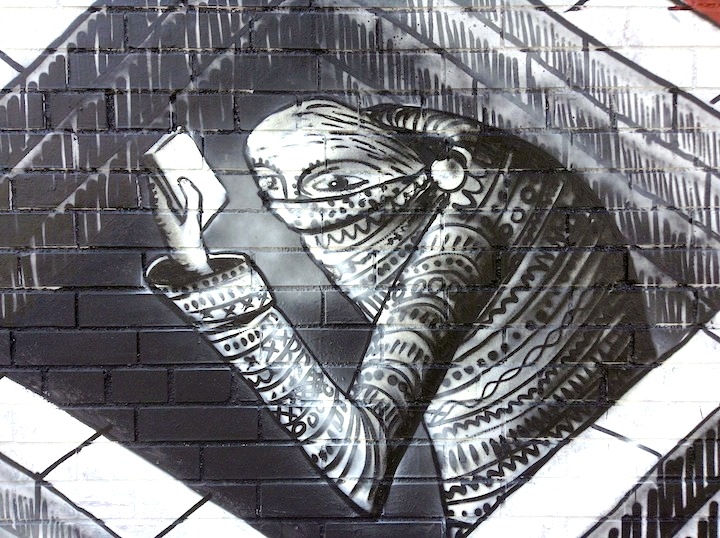
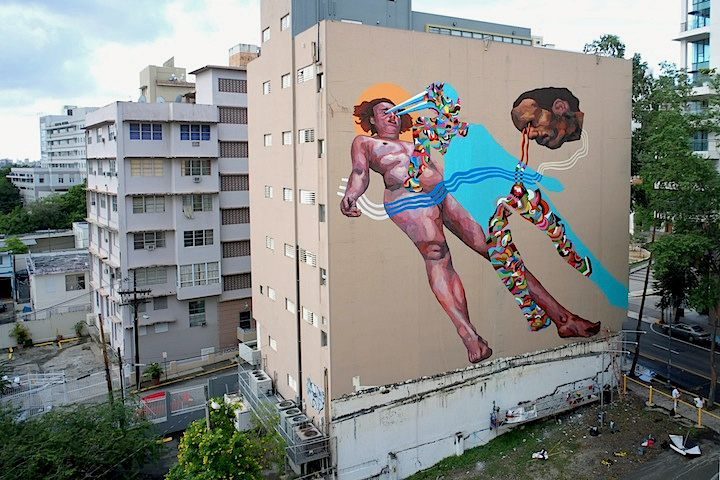
I’ve become more abstract and I’ve begun to think of the body as “just a dress to use on Earth.”  My portraits no longer have eyes.  And I’ve begun to use religious symbols obsessively in my work, even though I don’t believe in a traditional God. My work has also become more socially conscious.

What inspired that?

Before 2009, I was apolitical. But in 2009, I lived in Paris, and I began to think of art as the means to inspire societal change. The revolution must start here — on the walls.

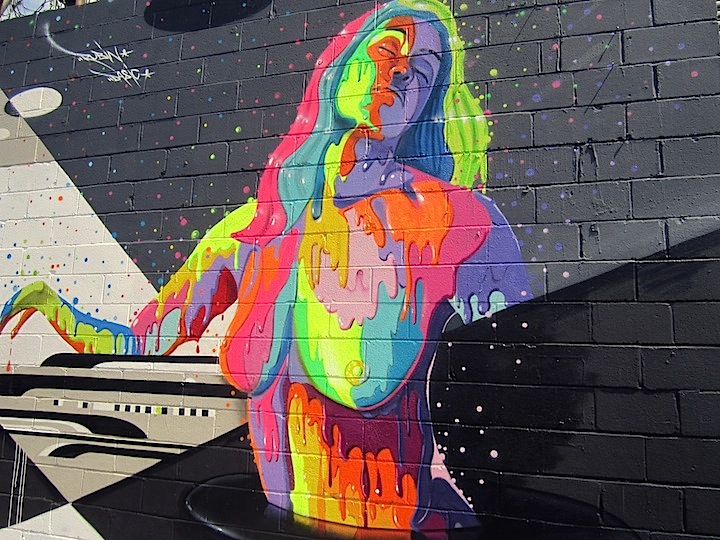
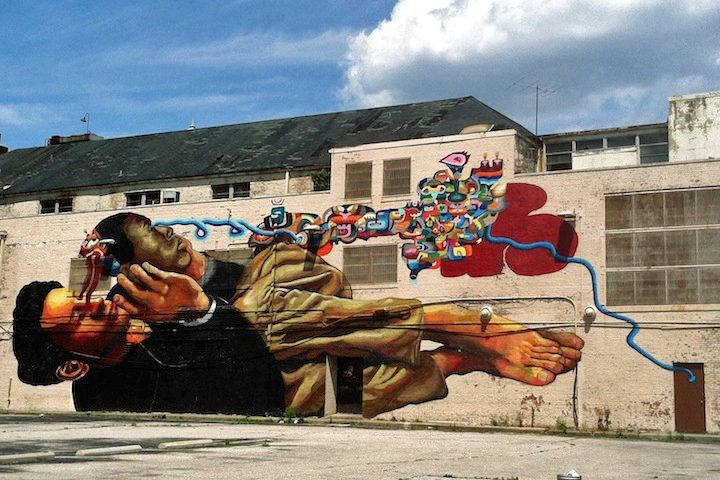
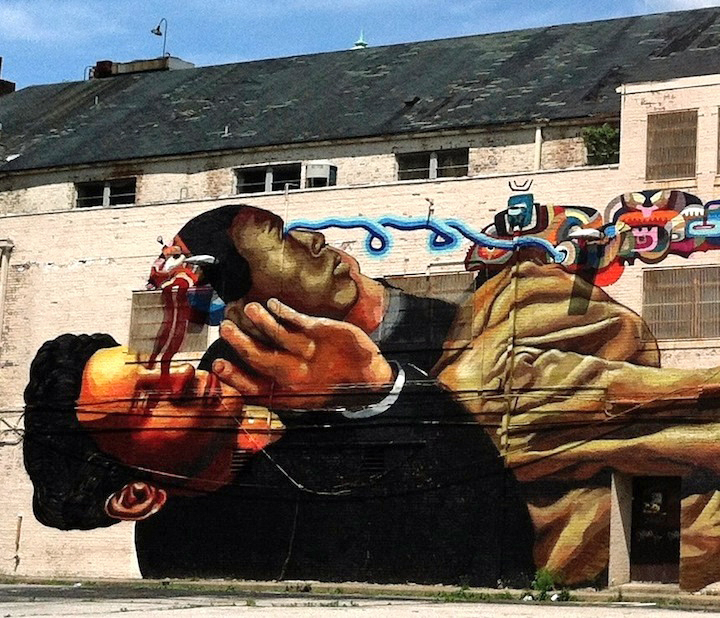
Interview by Lois Stavsky. Photos of Brooklyn rooftop and Baltimore mural by Lois Stavsky. Final image of wall in Santurce, Puerto Rico — which I caught only at the beginning — courtesy of the artist.

{ 0 comments }

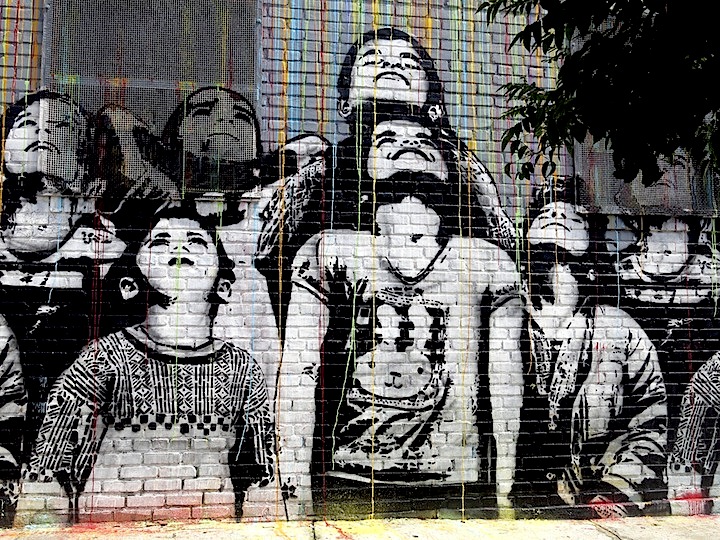
This is the second in a series of occasional posts featuring images of children that surface on NYC public spaces:

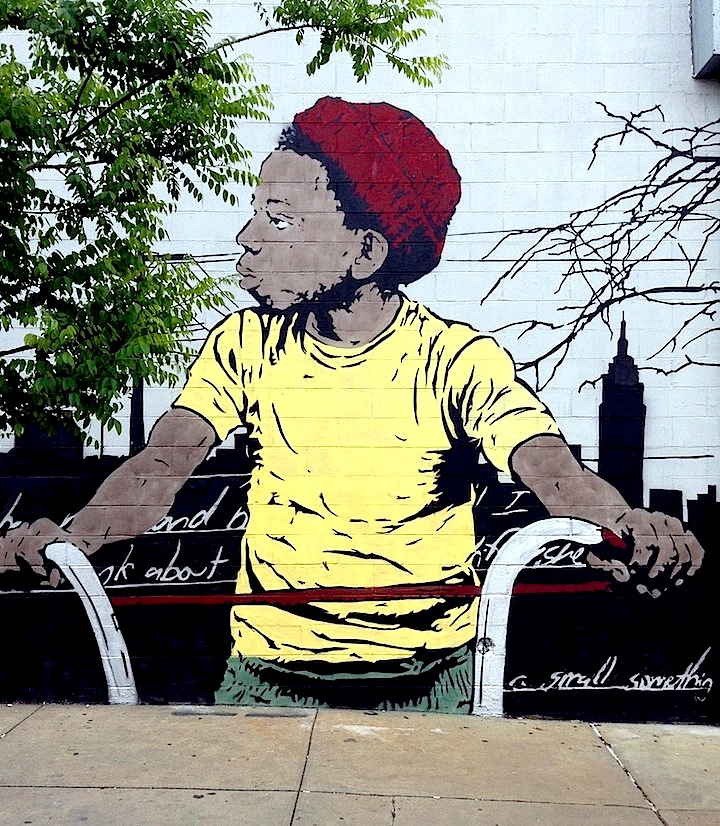
Chris Stain at the Bushwick Collective

Chris Stain

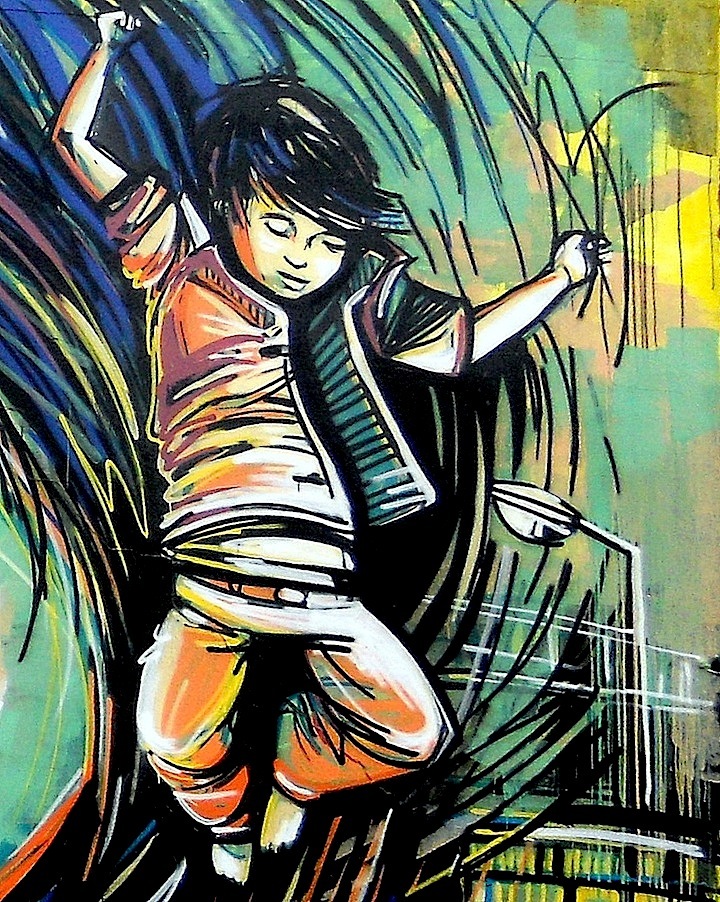
Alice Pasquiniclose-up from huge mural at the Bushwick Collective

Alice Pasquini

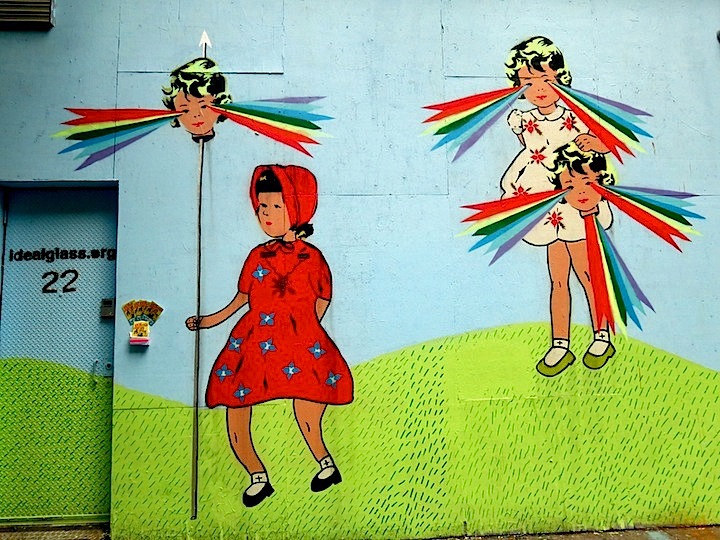
James Rubio in the East Village

James Rubio

Sonni at the Bushwick Collective

Sonni Adrian

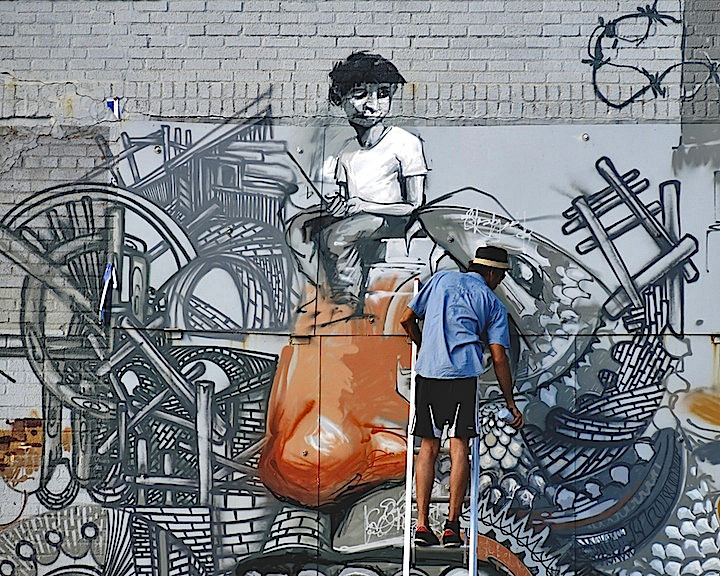
Icy and Sot, close-up from huge mural in Williamsburg, Brooklyn

Icy and Sot

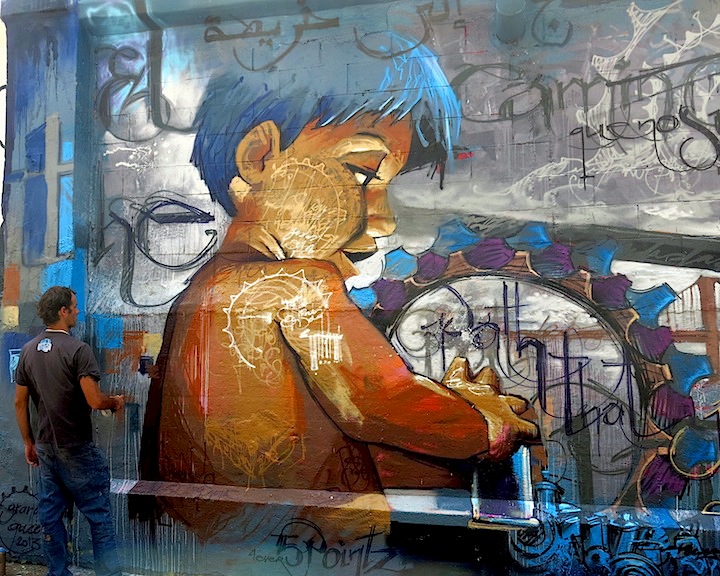
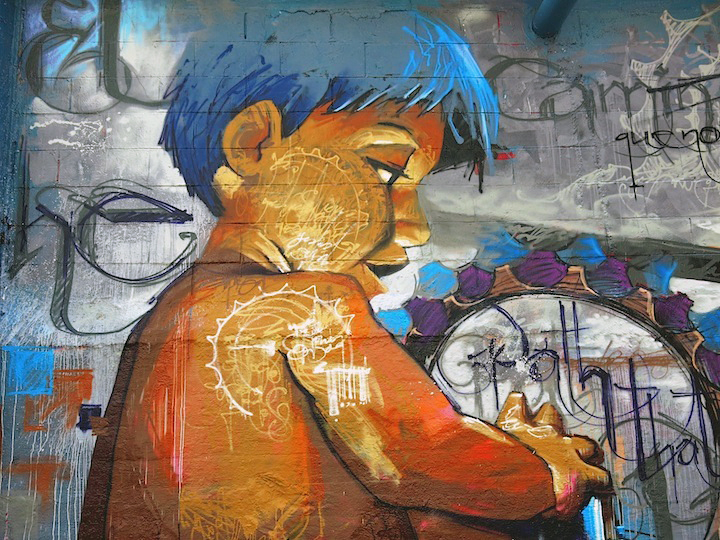
 El Niño De Las Pinturas, close-up from huge mural at 5Pointz in Long Island City

El Nino de las Pinturas

Fumero in Williamsburg, Brooklyn

Fumero

Lisete Alcalde at the Bushwick Collective

Lisete Alcalde

 Photos by Tara Murray and Lois Stavsky, except for Lisete Alcalde, courtesy of the artist

{ 0 comments }

Shepard Fairey

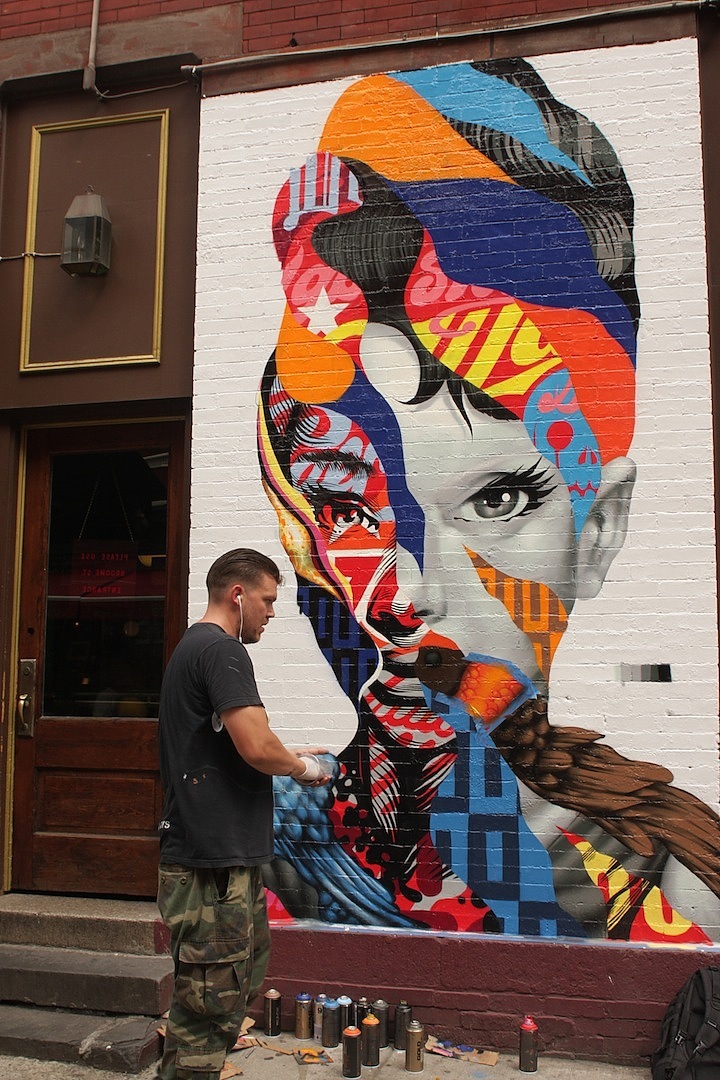
It’s been busy in DUMBO, Brooklyn. For the past week, some of our favorite artists have been gracing its walls with stylishly striking artwork, transforming its landscape into a stunning open-air gallery.

Shepard Fairey at work

Shepard Fairey

Faith47, close-up from completed mural

Faith 47

Another Faith47 close-up

Faith 47

DALeast, close-up from completed mural

DALeast

Another close-up from DalEast’s mural

DALeast

Eltono at work

ElTono

Another close-up from Eltono mural in progress

ElTono

MOMO, close-up 

MOMO

Another close-up from MOMO mural in progress

MOMO

These murals are among eight to grace a four-block stretch along the BQE. We will continue documenting DUMBO Walls on our Facebook page.

Photos by Dani Mozeson

{ 2 comments }

An award-winning multidisciplinary artist, Brazilian native Priscila De Carvalho currently lives and works in NYC.  We recently caught up with her in the Bronx, where she was working with local teens on a mural to commemorate the 40th anniversary of the Bronx Museum of the Arts.

Priscila De Carvalho

When and where did you do your first public mural?

In Puebla, Mexico a few years ago.

Are there any particular cultures that influence you aesthetic?

The street art culture and urban life, in general. I used to skateboard and surf back in Brazil.

Your work is not only beautiful; it also intellectually engages us. Does it have a particular message or theme?

Most of my work relates to the economic and socio-political issues surrounding the out-of-control urbanization of slum dwellers. I juxtapose my observations about sub-cultural communities with other contemporary issues such as climate change and pollution

Priscila De Carvalho

Do you work with a sketch-in-hand or do you let it flow?

I usually have a basic sketch design layout. But it doesn’t always go accordingly.

Do you generally work alone? How do you feel about collaborating with other artists?

Yes, most of the time I work alone or with some assistants. I enjoy working alone, but there’s also the communication and camaraderie — so important among artists — that only collaboration can bring.

What percentage of your time is devoted to your artwork?

At this point of my career, it’s a full time job. It’s not just the creative end of it. There’s also the administrative part. And gallery exhibits demand a huge amount of work…lots of business work, including networking.

Priscila De Carvalho

Any other passions?

Music. I studied piano for six years, but I just didn’t have what it demands.

As a muralist who works in sanctioned spaces, what are your thoughts about graffiti?

I’m highly inspired by graffiti — its energy and vitality.

Any thoughts about the graffiti/street art divide?

Graffiti has its distinct history and techniques.   It has evolved from tagging into a complex art form. Many street artists started as graffiti artists.  Street art and graffiti are connected.

Priscila De Carvalho

How do you feel about the movement of graffiti and street art into galleries?

It can turn art into a commodity. But it must remain an option, as every artist has to earn a living.

Where have you exhibited?

I’ve exhibited in Spain, London, Paris, Berlin, Nepal and Mexico. I had my first solo exhibition at The Jersey City Museum in 2009.

What’s the riskiest thing you’ve done as an artist?

In Nepal, I had to climb a 30-foot bamboo structure with no scaffolding. I was tied to a harness, and it was hard for me to visualize what I was painting. But it one of the most rewarding work/travel experiences I’ve had.

Priscila De Carvalho

Do you have a formal arts education?

No. I studied painting/sculpture informally for a few years before I started with my studio practice.

What’s ahead?

Some permanent public art projects and more exhibitions.

Interview by Lenny Collado; first photo by Lois Stavsky; all other images are courtesy of the artist.

{ 0 comments }

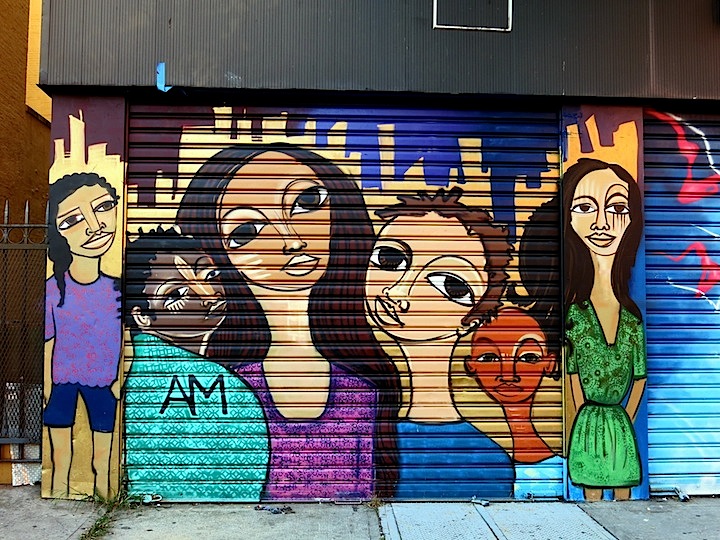
This is the fourth in an ongoing series featuring the range of faces that surface daily in NYC’s open spaces:

Alice Mizrachi aka AM at the Bushwick Collective

Alice Mizrachi

How and Nosm, close-up in the South Bronx

How and Nosm

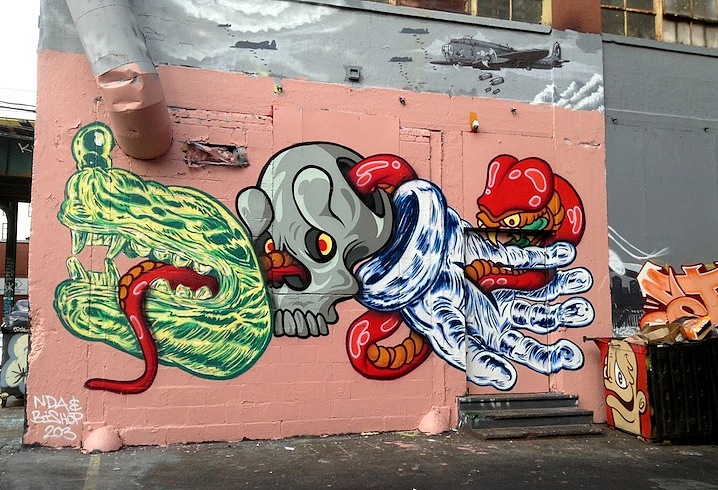
ND’A in Williamsburg, Brooklyn

NDA

Cern and Lee Quiñones in Fort Greene, Brooklyn

Cern and Lee Quinones

Carlos Pinto in Flatbush, Brooklyn

Carlos Pinto

Paul Richard in the East Village — on the pavement

Paul Richard

ECB on the Lower East Side

ECB

Photos by Dani Mozeson, Tara Murray and Lois Stavsky

{ 0 comments }

Damien Miksza, Cern and QRST

The once-abandoned trailer on East 1st Street off 1st Avenue in Manhattan’s East Village has once again been transformed into an intriguing canvas of urban art. Here are a few images we captured these past few days from Cycle 9 of the Centre-Fuge Public Art Project.

Cern at work

Cern

Cern, close-up

Cern

Damien Miksza at work

Damien Miksza

QRST at work

QRST

Cassie Lynn O’Neal at work

Cassie Lynn O’Neal

 Cake — close-up

Cake

Caroline Caldwell at work

Caroline Caldwell

Royce Bannon at work on collaborative piece with Korn

Royce Bannon and Korn

The curatorial vision of Pebbles Russell and Jonathan Nevillethe Centre-Fuge Public Art Project was conceived in 2011 in memory of Mike Hamm.  Submissions to Cycle 10 — due by August 26th — can be sent to centrefuge@gmail.com. Keep posted to our Facebook page for more images from Cycle 9

All photos by Tara Murray, except for final photo by Lois Stavsky.

{ 0 comments }

The walls at 5Pointz continue to showcase some of the most vibrant public art in NYC — or anywhere. Here’s a sampling of some artwork that has recently surfaced:

Puerto Rican artists Rimx and Nepo

Rimx and Nepo

Queens-based Kid Lew’s tribute to Trayvon Martin

Kid Lew

Jasper — in from Queensland, Australia

Jasper

New Jersey-based graff masters Demer, Rain and Kasso

Demer, Rain and Kasso

The Parisian Nok Crew

Nok

Serrano, Mas Paz, Rimx and Cortes fashion letters “PROC” for the Artist Process, a 5Pointz annual project coordinated by Marthalicia Matarrita 

Serrano, Mas Paz, Rimx, Cortes

Close-up from huge mural by French TD4 member, Zeso

Zeso

Photos by Dani Mozeson, Tara Murray & Lois Stavsky; image of Ked Lew’s mural courtesy of the artist

{ 0 comments }

Speaking with Miss 163

July 24, 2013

A graduate of Cooper Union and a Fulbright scholar, Bronx native Sharon de la Cruz aka Miss 163 is a passionate artist and activist. Her first solo exhibit, Wild Thing, can be seen through August 11th at bOb’s at 235 Eldridge Street on Manhattan’s Lower East Side.  Her most recent public mural surfaced last month on Boone Avenue in the Bronx.

Miss 163

When and where did you start getting up?

I was 17 and living in Florida. Life was dull. My mom bought me my first spray can and told me I could paint a landscape on the back fence.

How did that turn out?

It was terrible. I hated the way it looked. I was instantly discouraged and started bombing.

What, then, inspired you to start painting in public spaces?

During my junior year in college, I went to Amsterdam. I saw amazing — different — graff there, and I began to think of graffiti as art.

Miss 163

It seems that Europeans, in general, tend to respect graffiti as an art form far more than we do here in the States. Why do you suppose this is so?

Here — from early on — it was regarded as a symbol of chaos and vandalism.

We’ve seen your artwork in Brooklyn, in the Bronx and at 5Pointz. Where else have you gotten up?

I’ve painted all over Lima, Peru.

Did you paint alone in Lima or were you with a crew?

I painted with Maripussy Crew. There were six of us – five graffiti artists and one rapper. It was wonderful!

Miss 163

What is the riskiest thing you’ve done?

Painting way up high in Lima while standing on a rickety, wobbling ladder. It was not a good feeling!

Do you prefer to work on legal walls or on unsanctioned spaces?

I try to achieve a balance. It depends on the setting. But legal walls don’t have to be done in a rush and in the dark. And that’s an advantage.

Any thoughts about the movement of street art and graffiti into galleries?

It’s a different experience than painting on the streets. But I’d expect it to feel different. And that’s okay!

You designed a limited edition perfume bottle for Calvin Klein’s CK One Shock Street Edition For Her.  How do you feel about the merchandizing or branding of graffiti?

It’s okay. In the past, it helped me pay off loans.

Miss 163

What percentage of your time is devoted to art?

When I’m not doing it, I’m thinking about it.

Any thoughts about the graffiti/street art divide?

I think it’s silly. And as graffiti continues to evolve, the lines between the two continue to blur.

Why do you suppose the “art world” remains reluctant to accept graffiti as a legitimate art form?

Because it’s participatory, political and immediate, it is seen as a threat.

How do you feel about the role of the Internet in all of this?

I love it. One of my early inspirations was the Art Crimes web site.

Miss 163

Have you a formal art education?

Yes, I studied at LaGuardia High School, Dreyfoos School of The Arts and at Cooper Union.

Was your formal art education useful?

Absolutely. It encouraged me to evolve and explore. There’s nothing like being around people who believe in you and feel excited about what you are doing.

What inspires you these days?

I’m inspired by animation, cartoon characters and color.  In terms of themes, I’m concerned with “sister strength.” Raising and answering the question, “What does it mean to be a strong woman?”

Are there any particular cultures that have influenced your aesthetic?

Brazilian, Peruvian and Old School Graffiti

Miss 163

Do you work with a sketch-in-hand or just let it flow?

My basic idea comes from a sketch, and from there it flows.

Are you generally satisfied with your finished piece? 

Barely. I’m never satisfied.

How has your work evolved through the years?

I’m more willing to experiment, and my artwork is more detailed.

Any favorite artists?

Among them are: Inti, Nunca, Kano, Anarkia, Miss Van and my crew, Maripussy.

What do you see as the role of the artist in society?

A main role is to highlight issues and create a space for solutions.

Interview and final photo by Lois Stavsky; all other photos courtesy of the artist.

{ 0 comments }

This is the second in an occasional series featuring images of males who surface on NYC public spaces:

Chris RWK at the Woodward Gallery Project Space on Manhattan’s Lower East Side

Chris RWK

Luv1 at the Bushwick Collective

Luv1

RAE and Abel Macias in Bushwick, Brooklyn

RAE

Zimer does James Gandolfini at the Bushwick Collective

Zimer

Magdalena Marcenaro aka Magda Love in Cobble Hill, Brooklyn

Magda Love street art

The Dude Company does Talib Kweli in DUMBO, Brooklyn

The Dude Company

Owen Dippie in the Tremont section of the Bronx

Owen Dippie

Ces at Hunts Point in the Bronx

Ces

Icy and Sot in Prospect Heights, Brooklyn

Icy and Sot

Photos by Tara Murray and Lois Stavsky

{ 0 comments }

Speaking with Spidertag

July 18, 2013

Based in Madrid, Spidertag is known for his masterful geometrical and abstract artworks fashioned with yarn and nails. I recently met up with him during his visit to New York City, where he left his mark at 5Pointz.

Spidertag

When did you start getting up?

I started doing graffiti in 2000, and in 2008 I began working as Spidertag.

Have you any preferred surfaces?

I like abandoned places. Just like a spider, I only build my geometrical webs in out-of the way, deserted spaces. When people are present, a spider’s web does not last.

Have you ever been arrested?

Not for this, but I was arrested in Berlin for bombing.

What was that like?

They pepper-sprayed me and punched me. They kept me over night.

Spidertag

Wow! And I thought the authorities in Berlin were lenient!

Not if you’re caught bombing.

What percentage of your time is devoted to your art?

All day, all night.

What is your main source of income?

Freelance photography and design. Selling artworks.

Any thoughts about the graffiti/street art divide?

I try to connect them both. But, clearly, street art is more acceptable, and street artists have more freedom than graffiti writers. In some ways, street art legitimizes graffiti.

Spidertag

Do you prefer working alone or collaborating with others?

Both. I like working alone, but I also like the mix of techniques that comes with collaboration.

With whom have you collaborated?

Back in Spain, I collaborated with Señor X, Gaucholadri, EC13 and El Niño De Las Pinturas. And in Berlin, I collaborated with Hottea.

What do you see as the role of the Internet in all this?

It’s important  — because what we do is so ephemeral.

Have you a formal art education?

I studied sculpture, but most of what I do comes from what I taught myself and through reading. I’m an avid reader.

Spidertag

What’s the riskiest thing you ever did?

Doing art while standing in deep cold water. It was irresistible.

Your work is certainly unique. What is the source of your inspiration?

I love to experiment with different materials. I’m inspired by geometrics. And I’m always trying to do something different and better. Particular spots, also, inspire me.

Do you work with a sketch in hand or let it flow?

I usually don’t work with sketches.

Are you generally satisfied with your finished piece?

Sometimes. If I like it, it feels like magic. I jump for joy. And if I don’t like it, I forget about it.

Spidertag

Are there any particular cultures that have influenced your aesthetic?

Egyptian.

How has your work evolved through the years?

I’m more engaged with the materials that I use. These days nails have a hold on me. And I’m more particular with the spots that I choose.

What’s ahead?

A movie is coming soon. More experimentation, more geometry. I don’t want to repeat myself. I would like to Spidertag an entire abandoned town, my dreamed kingdom.

Gee – that’s quite ambitious. It sounds great! What do you see as the role of the artist in society?

I wish the artist did have a significant role in society. I’m not sure he does. But the way I see it — his main goal is to teach others to follow their hearts.

Interview by Lois Stavsky. First two images photographed by Lois Stavsky at 5Pointz in Long Island City, Queens. All other photos are courtesy of the artist.
{ 8 comments }